
Tungsten Market on Track to Reach $8.77 Billion by 2035 as Defense and Semiconductor Demand Reshape Supply Chains
Tungsten Market (2026 - 2035)
China alone controls the majority of concentrate conversion, and Asia-Pacific holds 54.2% of 2025 volume and continues to grow at the quickest rate of 5.37%
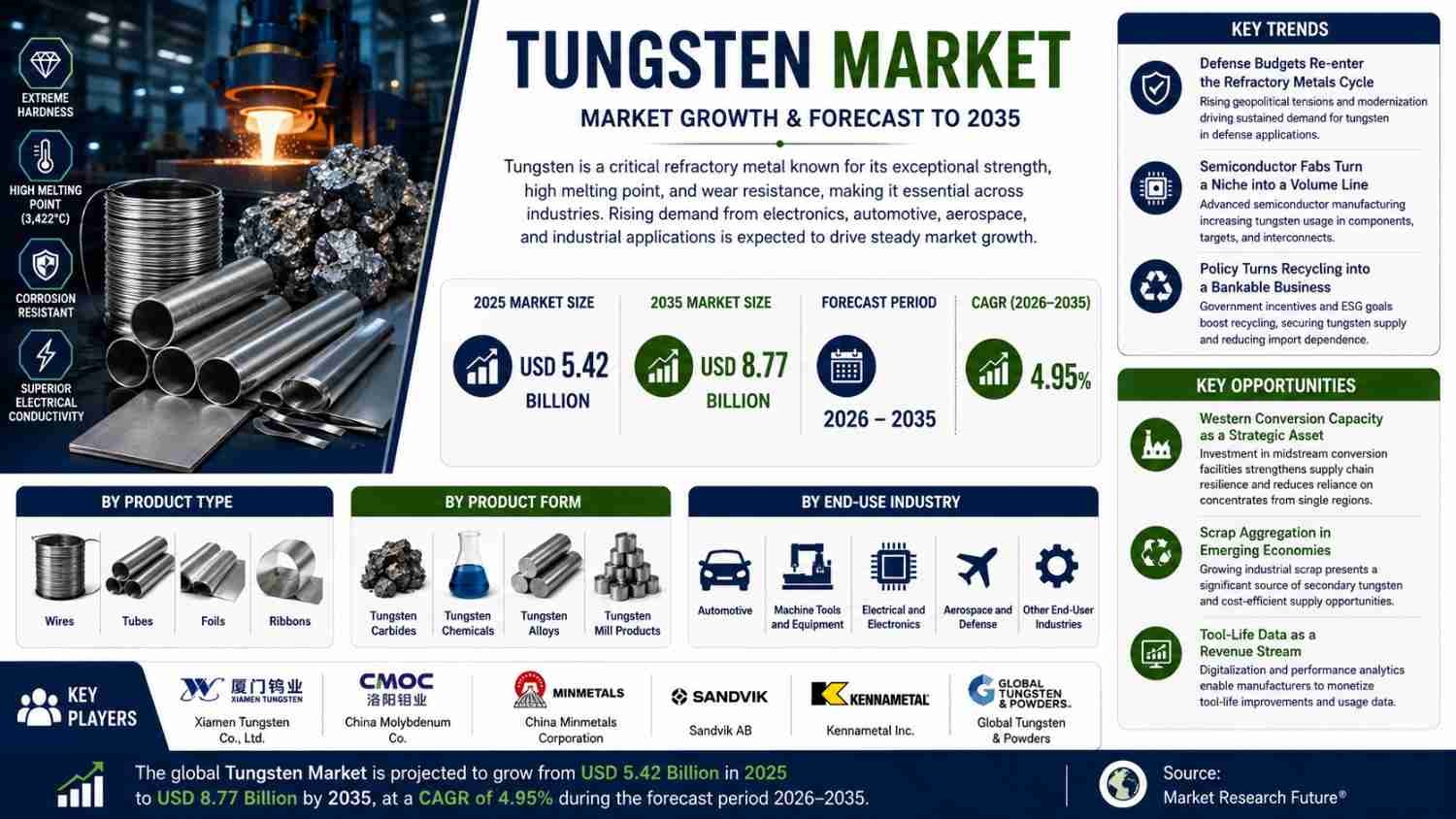
TX, UNITED STATES, August 19, 2026 /EINPresswire.com/ -- The global tungsten market is entering a new phase of strategic importance. Valued at an estimated $5.42 billion in 2025, the market is projected to grow from $5.68 billion in 2026 to approximately $8.77 billion by 2035, registering a compound annual growth rate of 4.95%. This expansion is being driven by a convergence of defense rearmament programs, semiconductor fabrication buildouts, and critical raw materials policies that are transforming tungsten from an industrial commodity into a geopolitically sensitive strategic asset.The Geopolitical Supply Squeeze
The defining tension in the tungsten market is the yawning gap between where the metal is mined and where it is consumed. China alone controls roughly 80% of global concentrate conversion, a concentration that became painfully visible in February 2025 when Beijing added tungsten to its dual-use export control list. The resulting licensing requirements, running 45 to 90 days, caused spot ammonium paratungstate prices in Rotterdam to jump 34% within two quarters. Since no Western substitution plan can close that supply gap before 2029, buyers have responded by building six-to-nine-month safety stocks, which itself distorts demand signals and inflates working capital requirements.
This vulnerability has triggered an unprecedented policy response. The European Union's Critical Raw Materials Act, which entered force in May 2024, sets binding 2030 benchmarks of 10% extraction, 40% processing, and 25% recycling for listed strategic materials including tungsten. The Act has already pulled roughly EUR 2.1 billion in announced refining capital toward Iberia and Central Europe. In parallel, Washington allocated $435 million under Defense Production Act Title III specifically for domestic tungsten and refractory metals conversion, citing complete U.S. import reliance on concentrate. These twin policy frameworks are redirecting capital toward Western conversion capacity at a pace not seen since the Cold War.
Market Size and Forecast Trajectory
Market Research Future's estimates blend customs-level trade flows, converter capacity audits, and end-use consumption modeling across 14 countries, triangulated against U.S. Geological Survey commodity balances and International Tungsten Industry Association shipment data. Volume is converted to value using annual average APT reference pricing. The market has grown from $4.31 billion in 2021 and is expected to reach $6.26 billion by 2028 before climbing steadily toward the $8.77 billion endpoint in 2035.
Segment Analysis by Product Type
Tungsten wires command the largest product type share, capturing approximately 37% of market revenue in 2025. This dominance reflects the metal's unmatched combination of tensile strength and melting point in electrical-discharge machining electrodes and high-temperature furnace heating elements, where no credible substitute exists at scale.
Tungsten tubes represent the fastest-growing product type, projected to expand at a 5.45% CAGR through 2035. This acceleration is being driven by aerospace original equipment manufacturers qualifying tungsten-alloy throat inserts for hypersonic propulsion programs, a demand stream that has raised order books sharply since 2024. Tungsten foils were valued at approximately $1.21 billion in 2025, serving electronics shielding and radiation applications. Ribbons captured roughly 17.8% of the market, anchored by lighting, vacuum, and sensor assemblies.
Download Report Sample Copy: https://www.marketresearchfuture.com/sample_request/7050
Segment Analysis by Product Form
Tungsten carbides dominate by product form, accounting for approximately 48.7% of total volume in 2025. This structural dominance reflects the fact that cutting tools consume roughly half of all refined tungsten globally, and cemented carbide inserts now replace legacy high-speed steel tooling across precision machining applications due to efficiency advantages and four-to-six-times-longer lifespan. Within this segment, cobalt-heavy alloy formulations are being actively reformulated to reduce supply risk from the Democratic Republic of Congo.
Tungsten chemicals represent the fastest-growing product form, advancing at a 5.85% CAGR. Ammonium paratungstate and hexafluoride derivatives feed semiconductor deposition processes and catalyst applications where volumes are small but pricing is exceptional, carrying premiums of roughly 3.5 times standard grades. Purity qualification cycles of 18 to 24 months also lock incumbent suppliers in place, creating formidable barriers to entry.
Tungsten alloys were valued at approximately $1.15 billion in 2025, serving defense kinetic penetrators and radiation shielding. Tungsten mill products captured roughly 17.9% of the market, supplying electrodes, sputtering targets, and furnace hardware.
Segment Analysis by End-Use Industry
The automotive sector remains the largest end-use industry, commanding approximately 28% of demand in 2025. However, its growth is now paced by the electric vehicle transition rather than traditional volume expansion. EV production requires roughly 22% more carbide tooling per vehicle than internal-combustion equivalents, driven by aluminum-intensive structures and battery-housing machining. Against International Energy Agency projections of 45 million annual EV sales by 2030, this structural shift provides a durable demand tailwind even as powertrain simplification offsets some traditional tooling needs.
Machine tools and equipment contributed approximately $1.33 billion in 2025, tracking global industrial capital expenditure cycles. The electrical and electronics sector captured roughly 21.4% of the market, with semiconductor fabrication emerging as the most consequential demand stream. Every advanced logic node relies on tungsten for contact plugs and interconnect barriers, and TSMC, Intel, and Samsung have collectively committed above $380 billion in fab capital expenditure through 2030. Ultra-high-purity chemical feedstock serves this market, with fewer than six qualified suppliers worldwide capable of meeting the 99.999% purity specifications required by advanced fabs.
Aerospace and defense is the fastest-growing established end-use segment, expanding at a 4.92% CAGR. NATO members committed to 2% GDP defense spending have collectively added $118 billion in annual outlays since 2022, with kinetic penetrators, armor packages, and rocket-nozzle throats all drawing on tungsten-heavy alloys. U.S. procurement cycles for these programs run seven to twelve years, creating sticky, long-term demand visibility.
Other end-user industries, spanning batteries, medical imaging, and energy applications, represent the fastest-growing category overall at a 5.65% CAGR. Tungsten-based anodes in flow-battery research and collimator components in CT systems represent small but fast-compounding demand pools that are growing well above the market average.
Buy Now: https://www.marketresearchfuture.com/checkout?currency=one_user-USD&report_id=7050
Regional Landscape: Asia-Pacific Dominates, West Pursues Resilience
Asia-Pacific captured approximately 54.2% of global market volume in 2025 and continues to grow at the fastest regional pace of 5.37% through 2035. This dominance reflects where conversion capacity sits rather than where ore is mined, a distinction that matters profoundly for supply risk modeling. China alone accounts for roughly 68.4% of the regional share through Xiamen Tungsten and CMOC, which control ore, conversion, and downstream carbide simultaneously, allowing them to absorb price shocks that would strand standalone converters elsewhere. India is expanding at a 5.88% CAGR, driven by auto component machining and scrap recovery growth. Japan contributed approximately $386 million, focused on high-purity chemicals for electronics. South Korea is growing at a 5.61% CAGR, anchored by the Sangdong mine restart and domestic semiconductor fab demand. The ASEAN bloc holds roughly 6.1% of the regional share through Vietnamese recycling and Nui Phao output.
North America contributed approximately $1.02 billion in 2025, representing roughly 18.9% of global volume. The region's position rests on demand rather than supply, as it mines almost nothing and converts modestly. The United States dominates the regional landscape with approximately $812 million in demand, fueled by Defense Production Act Title III funding and Pentagon stockpile targets. Canada is growing at a 5.12% CAGR through Northwest Territories deposit development. Mexico captured roughly 13.4% of the regional share through automotive tooling clusters in the Bajío region.
Europe holds approximately 17.6% of global market share and is projected to grow at a 4.58% CAGR. Germany anchors the region with roughly 27.8% of European demand through its machine-tool and automotive tooling base. The United Kingdom contributed approximately $118 million, driven by aerospace fastener and nozzle demand. France is expanding at a 4.71% CAGR through nuclear and defense component orders. Italy holds roughly 11.2% of the regional share through precision die and mold manufacturing. Spain contributed approximately $96 million, with the Barruecopardo mine restart offering meaningful non-Chinese primary supply. The Nordic countries are growing at a 4.42% CAGR through mining wear parts and drilling consumables. Russia captured roughly 6.8% of regional share through domestic defense consumption. The rest of Europe, including Austrian and Portuguese conversion capacity, contributed approximately $74 million. Europe's regulatory posture is the most aggressive globally, though whether permitting keeps pace with policy ambition remains an open question.
South America accounted for approximately 4.6% of global volume. Brazil dominates with roughly 61.5% of the regional share, with demand tracking mining and agricultural equipment wear parts almost one-for-one. Argentina is growing at a 4.88% CAGR, driven by lithium project drilling consumables. The rest of South America contributed approximately $42 million through Peruvian and Bolivian concentrate exports.
The Middle East and Africa region captured roughly 4.7% of global volume. Saudi Arabia leads with approximately 31.2% of regional share through Vision 2030 industrial and oilfield tooling programs. The United Arab Emirates contributed approximately $51 million as a trading, re-export, and logistics hub. South Africa is growing at a 5.24% CAGR through deep-level mining consumables. Egypt captured roughly 9.4% of the regional share through construction and cement plant wear parts. Rwanda's formalization of artisanal wolframite ore output under ITSCI traceability has turned a compliance headache into a legitimate Western supply option, with certified tonnage roughly tripling since 2020.
Report Summary: https://www.marketresearchfuture.com/reports/tungsten-market-7050
Competitive Landscape
The tungsten market exhibits medium concentration, with an estimated Herfindahl-Hirschman Index near 1,150 and the top five suppliers holding roughly 41 to 46% of refined output. Chinese integrated producers dominate upstream conversion while Western firms hold downstream tooling and specialty chemistry, a split that makes the market look more fragmented in value terms than it is in tonnage terms.
Xiamen Tungsten Co. leads with an estimated 11 to 14% revenue share as a fully integrated mine-to-tool leader spanning APT, powders, carbide, and mill products. China Molybdenum Co. captures roughly 8 to 11% through upstream scale with byproduct economics across concentrate, APT, and intermediate chemicals. China Minmetals Corporation holds approximately 6 to 9% through state-linked distribution reach across concentrate, powders, and carbide blanks.
Sandvik AB accounts for roughly 6 to 8% as a digital tooling and recycling leader, with sensor-enabled insert families enabling outcome-based contracting. Kennametal Inc. captures approximately 5 to 7% with an aerospace and energy tooling focus, and in March 2024 opened an expanded recycling facility in Pennsylvania to lift secondary feedstock recovery capacity.
Global Tungsten and Powders, part of the Plansee Group, holds roughly 4 to 6% as a Western supply-security anchor across powders, carbide, and mill products. CERATIZIT Group captures approximately 3 to 5% as a European precision tooling specialist. Mitsubishi Materials Corporation holds roughly 3 to 5% with closed-loop scrap recovery capabilities. H.C. Starck Tungsten GmbH accounts for approximately 2 to 4% in the semiconductor-grade purity niche.
Japan New Metals Co. captures roughly 2 to 3% as an electronics-grade supplier to Asian fabs. Almonty Industries holds approximately 1 to 3% as a non-Chinese primary supply developer, and in July 2024 completed commissioning milestones at the Sangdong project in South Korea, positioning it as the largest non-Chinese primary source outside China. A.L.M.T. Corp. rounds out the competitive set with roughly 1 to 2% through specialty component fabrication.
Similar Report
tungsten products market https://www.marketresearchfuture.com/reports/tungsten-products-market-25479
tungsten wire market https://www.marketresearchfuture.com/reports/tungsten-wire-market-23800
Tungsten Carbide Powder Market https://www.marketresearchfuture.com/reports/tungsten-carbide-powder-market-5983
Tungsten Market https://www.marketresearchfuture.com/reports/tungsten-market-7050
Market Research Future
Market Research Future
+1 855-661-4441
email us here
Legal Disclaimer:
EIN Presswire provides this news content "as is" without warranty of any kind. We do not accept any responsibility or liability for the accuracy, content, images, videos, licenses, completeness, legality, or reliability of the information contained in this article. If you have any complaints or copyright issues related to this article, kindly contact the author above.
